 |
|
|
|
|
|
 |
|
 |
|
||
 |
|
||||
Sales of theatrical clothes and disguises (jabot shirts with or without lace, cape, hats, wigs and Venetian masks, vests and old trousers) for all public, weddings, fancy dress, costumers, and public spectacles.
Also discover on our website all personal achievements, available from stock in our warehouse in Paris.
On our WEB site, you can :
- To buy by correspondence
via this WEB site
and even
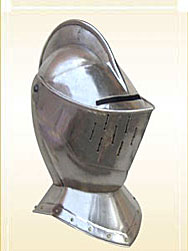
Bacinet helmet
CONTACT : THEATRHALL
Phone calls to France: + 33.1.43.26.64.90 (after 15h)
N° VAT Intracomm. - SIRET - APE - RIB - General Conditions of Sale
teatral teatrall teatrale teatrales téâtral
téâtrall
téâtrale téâtrales théâtral théâtrall
théâtrale théâtrales theatral
theatrall theatrale theatrales theatre hall theatre all teatrhall teatre
hall
medieval, medieval helmet, medieval accessories,
armor, helmets medieval
helmet, helmets Templar, pelvis, helmet Roman Trojan helmet,
Greek helmet, Corinthian helmet
accessories medieval armor,
helmets, helmets Templar, pelvis, Roman helmets, helmets trojans,
Greek helmets, helmets Corinthian
The bacinet, medieval helmet, dates back to
the beginning of XIII century. At its inception, this is
a cervelière on which set a rail (A metal miec
protecting the face and can get up or down). It is
that around 1350, under King John, that the helmet bacinet takes its
forms
functional. At that time, a Bavaria is fixed to the walls below
tymbre of a visor to n'étrangle not the neck.
The men of French weapons of that era frequently helmets
bacinets from high italy. These helmets have not bacinets Italian
Bavarian tymbre but have a large enough so that the visor
does not fall on his neck. Tymbre of the French is much bacinet
more tilted back in order to provide less resistance
launches shots. The holes for breathing in the visor are
Most placed on the right side, because the blow dealt to launch left.
With the advent of armor plates, helmets bacinet
is adding a
colletin one or two rooms. The helmet bacinet has evolved over
weather. These developments were aimed finding the form giving
the least taken the blows possible. Thus, in 1400-1410, the helmet bacinet
no longer the beating surfaces. Thus, unless the coup
is perpendicular, he slipped on the helmet.
Great names of chivalry and our history
have worn helmets bacinets:
Jeanne d'Arc, Du Guesclin
The cervelières are protections mediaeval head of the most widespread
Middle age. Relatively cheap to produce, they provided
good protection from the top of the head (the "brains"), while
maintaining
excellent visibility.
Our helmets are medieval combat-capable,
they are steel rivets
1.5 mm thick and reinforced with steel bands of 1.5 mm thick;
nasal protections are steel 3 mm. All helmets are
fitted with a leather interior cap for setting the tower head
and a strap loop with medieval maintaining they agree
for leading tours up to 62.